


How Galo Captured M17 With a Smartphone
 < User Story·Vol.19 >
8 min read
Welcome to the nineteenth edition of our User Story series. This time, we're traveling to the Hermitage of Santa María de Melque, where Galo Alcolea (@galcolea) used NOMAD with a smartphone and a 400mm teleconverter to capture M17, revealing rich detail and color with just 15 light frames.
🔭 From Star Trails to Deep-Sky Photography
My name is Galo Alcolea. I am an astrophotographer and a technology enthusiast, especially when it comes to mobile phones.
With the evolution of cameras in these devices, I set out to apply traditional astrophotography techniques to them and see what they are capable of.
I first ventured into star trails, Milky Way shots, and Milky Way panoramas,and then made the leap to deep-sky objects. I have also designed and manufactured accessories such as a flat panel and Bahtinov masks tailoredfor mobile use.
As you can see from my Instagram profile, the results are very promising, though I will continue researching and improving my techniques—of course,with the help of Move Shoot Move.
✨ The Story Behind My M17 Photo
I captured this image of M17 from a very special location: the Hermitage of Santa María de Melque. It is built upon the ruins of an ancient monastery dating back to around 700–750 AD.
It is a site much loved by astrophotography enthusiasts.
The story behind the image is that back in 2025, when Comet R2 Swan passed near Earth, I photographed it while it was close to the M17 and M18 nebulae(I've attached a copy of that image).
I used a phone with a 200mm teleconverter, aided even then by the MSM NOMAD tracker.
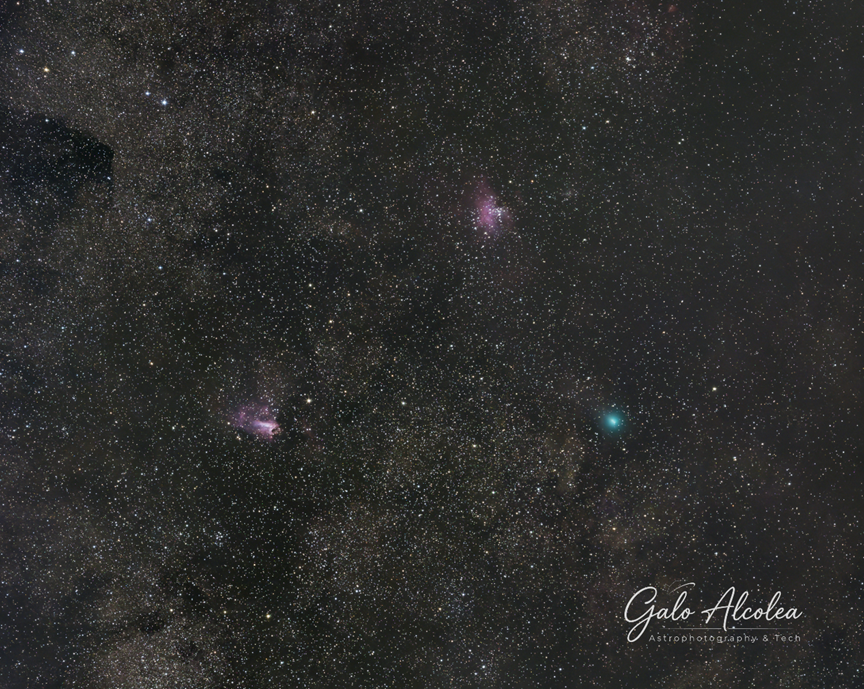
M16 / M17 / Comet R2 Swan
A few weeks ago, I decided to take the opportunity to capture one of those objects again—this time using a new phone compatible with a 400mm teleconverter. I chose M17.
🎯 The Challenge of Tracking at 400mm
The biggest challenge I face at these focal lengths is achieving perfect tracking; otherwise, I wouldn't be able to take exposures longer than 10 or 15 seconds.
On this occasion, the tracking was quite precise, allowing meto capture 25-second exposures. The results speak for themselves: with just 15 light frames, I achieved excellent detail and color.
The need for such precise tracking at high focal lengths is exactly what sparked my interest in the MSM Harmonic I—a device I would love to try out.
📝 Tips for Smartphone Deep-Sky Photography
1. Align Precisely
When using a focal length equivalent to 400mm, a precise alignment is essential.
2. Choose Low-Wind Nights
Look for low-wind nights, as the setup is very lightweight and therefore sensitive to vibrations.
3. Keep Exposures and ISO Down
Maximum exposure times in Smartphone cameras are around 30 seconds, but these sensors struggle with long exposures since they lack the heat-dissipation capabilities of dedicated cameras.
To avoid noise, it is best to keep exposures between 15 and 20 seconds and not exceed ISO 1250.
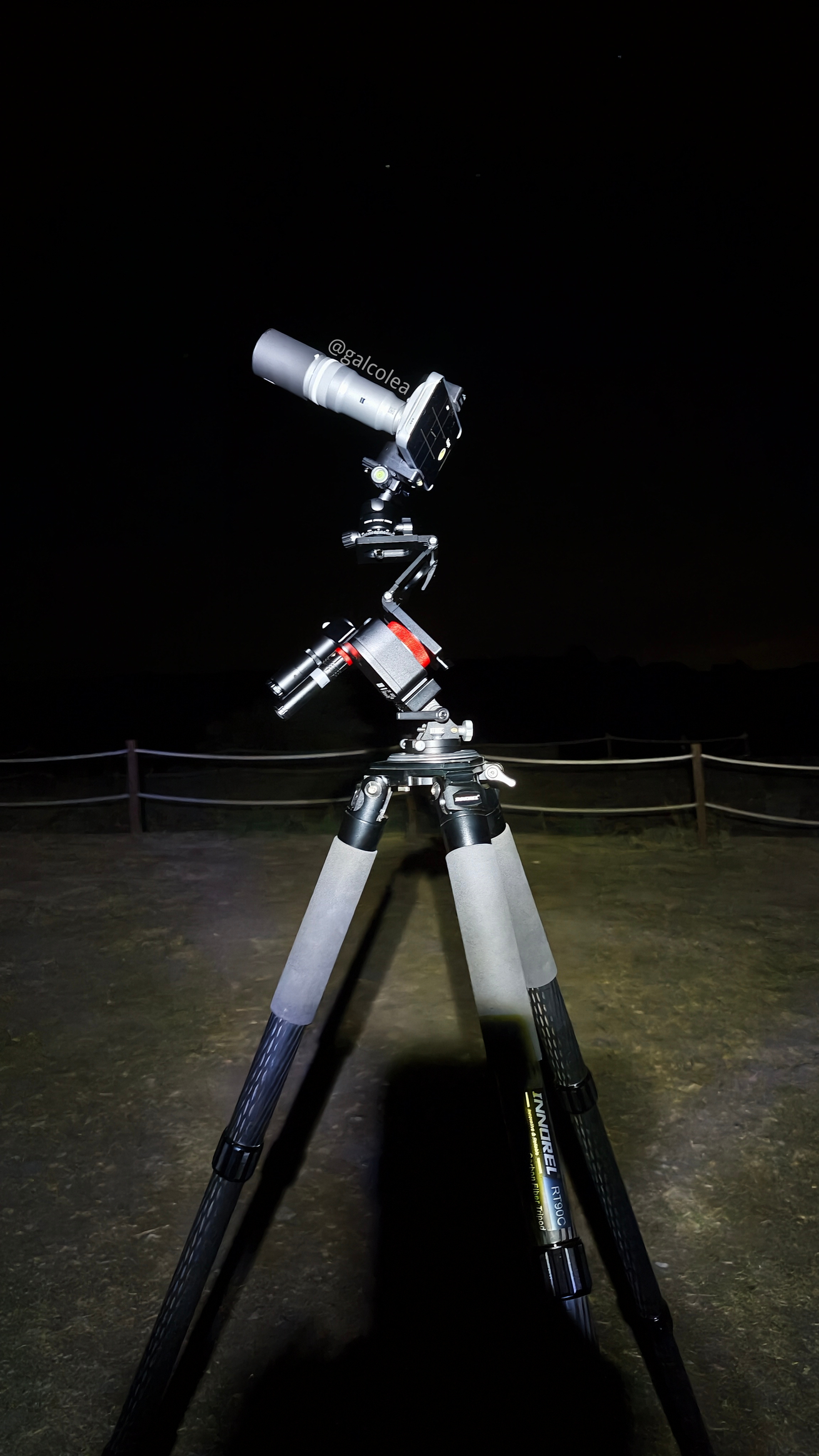
Gear List |
|
|---|---|
|
Phone |
vivo X300 Ultra |
|
Teleconverter |
vivo/Zeiss 400mm teleconverter |
|
Star Tracker |
|
|
Polar alignment |
|
|
Mount |
|
|
Accessory |
|
|
Shooting mode |
Pro mode and RAW format |
Leave a comment