


A First Eclipse, A Lasting Memory

< User Story·Vol.17 >
8 min read
Welcome to the seventeenth edition of our User Story series.
This time, we're traveling to Cuenca, Spain, where Marian González (@prayformarian) used NOMAD to follow the Sun during a first encounter with totality, capturing its fleeting beauty while sharing the moment with family.
📷 My first total eclipse: beyond the photography
Last August 12th was my first time seeing a total solar eclipse. I have quite a lot of experience in astrophotography and nightscape photography, but this was going to be my first time photographing a solar eclipse.
I had read a lot about it: what gear to use, how to set up the camera, what astronomical phenomena I was going to see during that unique event.
And still, I think this is a feeling shared by everyone who could see it: nothing I read before came close to the magnitude of actually living it.
Despite the rehearsals I had done, the nerves and excitement of the moment made me slip up while taking photos, but even though my photos didn't come out perfect, I wouldn't change having lived it together with my family.
I traveled to the path of totality in Cuenca (Spain) and set up all my gear as planned. I used my Canon R6 Mark II with a lightweight telephoto lens, the Canon RF 100-400, and a Baader solar film as a filter.
I didn't want to lose the Sun from the frame and have to keep reframing all the time, so I used my NOMAD tracker to follow the Sun.
Since it's not possible to align with Polaris during the day, I used Eric Wilkes' phone mount and the PhotoPills app for the alignment. The tracking worked perfectly, and NOMAD kept the Sun centered in the frame during the whole eclipse.
🔭 Technique, Timing and Takeaways
I started from the base sequence recommended by Toni Cladera, from PhotoPills, who shared all his tips and experience with the whole community (thank you!): f/8, ISO 100, and 1/500.
During the partial phase, I did a 5-frame bracket with 1.3 EV between exposures.
I had a timer set to remind me approximately every 5 minutes to take the shots during the partial phase, and to keep adjusting the ISO for the correct exposure.
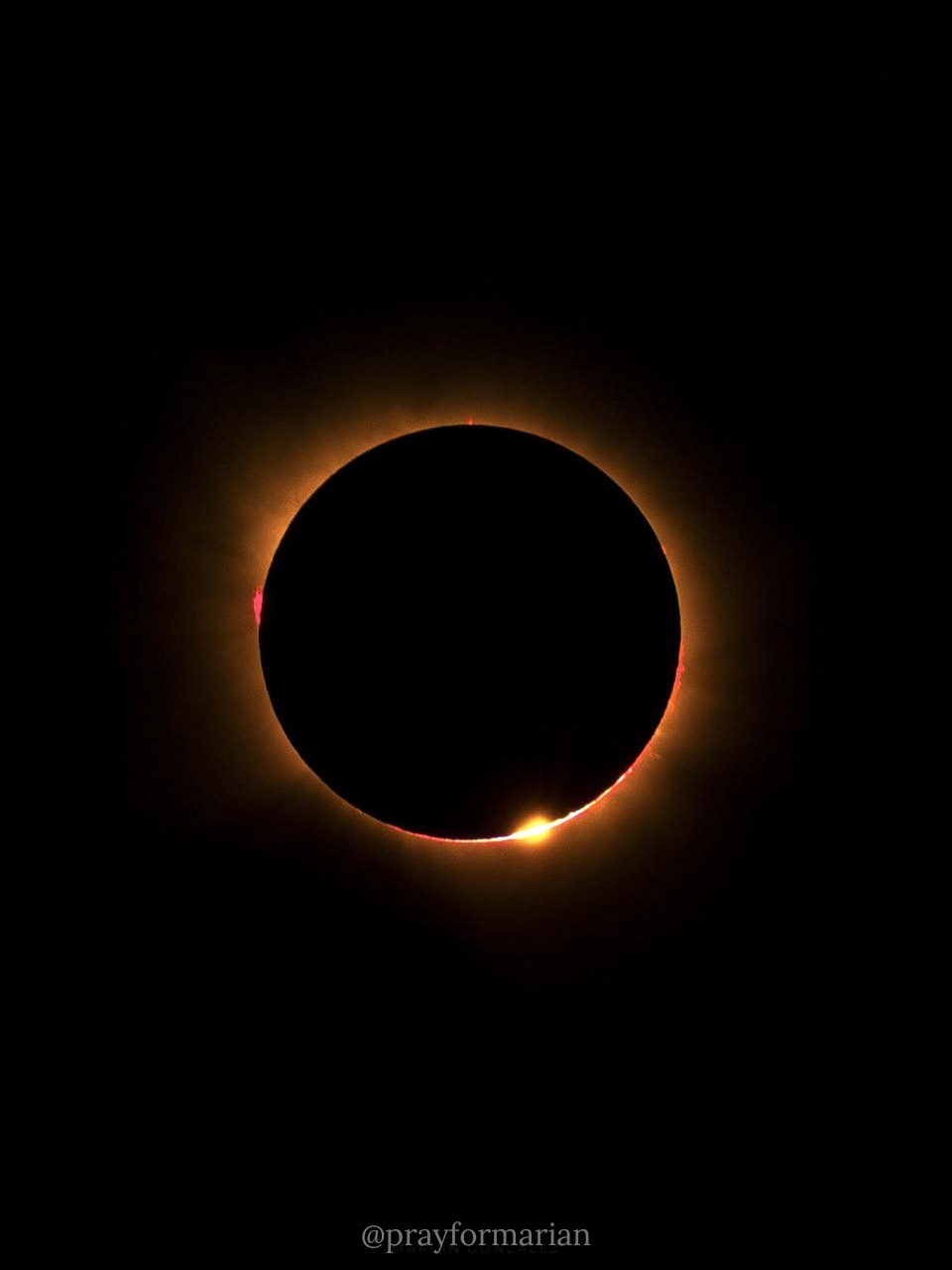
The Solar Eclipse Timer app was also showing me how the eclipse was progressing, so when the diamond ring and Baily's beads arrived, I only had to remove the solar filter and shoot 7-frame sequences at 1.3 EV with the intervalometer until totality arrived.
At that point, I lowered the shutter speed to 1/15 and continued with the same bracketing sequence.
And then I broke down. My brain couldn't take in so much beauty and my eyes almost filled with tears. I saw my family enjoying it and completely forgot about the camera.
My hands were shaking so much that I could barely switch back to the base settings, and I actually forgot to do it until I had almost missed the second diamond ring and Baily's beads.
That had been the most impressive thing I had ever seen. No photo, no video, no reading comes even close to what it really was. One of those things that stay with you forever.
Despite the nerves, I got the photos I had dreamed of. And I also took an important lesson with me: the photos were not the most important thing.
My advice is that if you get the chance to enjoy another total solar eclipse, live it.
There will be millions of photos of the eclipse, probably all pretty much the same, but if you live the experience, you will have made it your own.
💡 Tips
1.Rehearse Before Totality
Rehearse your shooting sequence several times before the eclipse. During totality there is no time to think.
2.Track More, Reframe Less
If you work with long focal lengths, use a tracker like NOMAD: it frees you from reframing and lets you focus on shooting.
3.Timing Is Key
Use an app like Solar Eclipse Timer to let you know about each phase, and the best moment to remove the filter.
4.Reset After Totality
Pay close attention to switching back to the base settings after totality, it's easy to get overwhelmed and forget about it.
5.Experience Totality Beyond the Camera
Totality doesn't last long, so enjoy it. It's worth living part of it without the camera in the way.
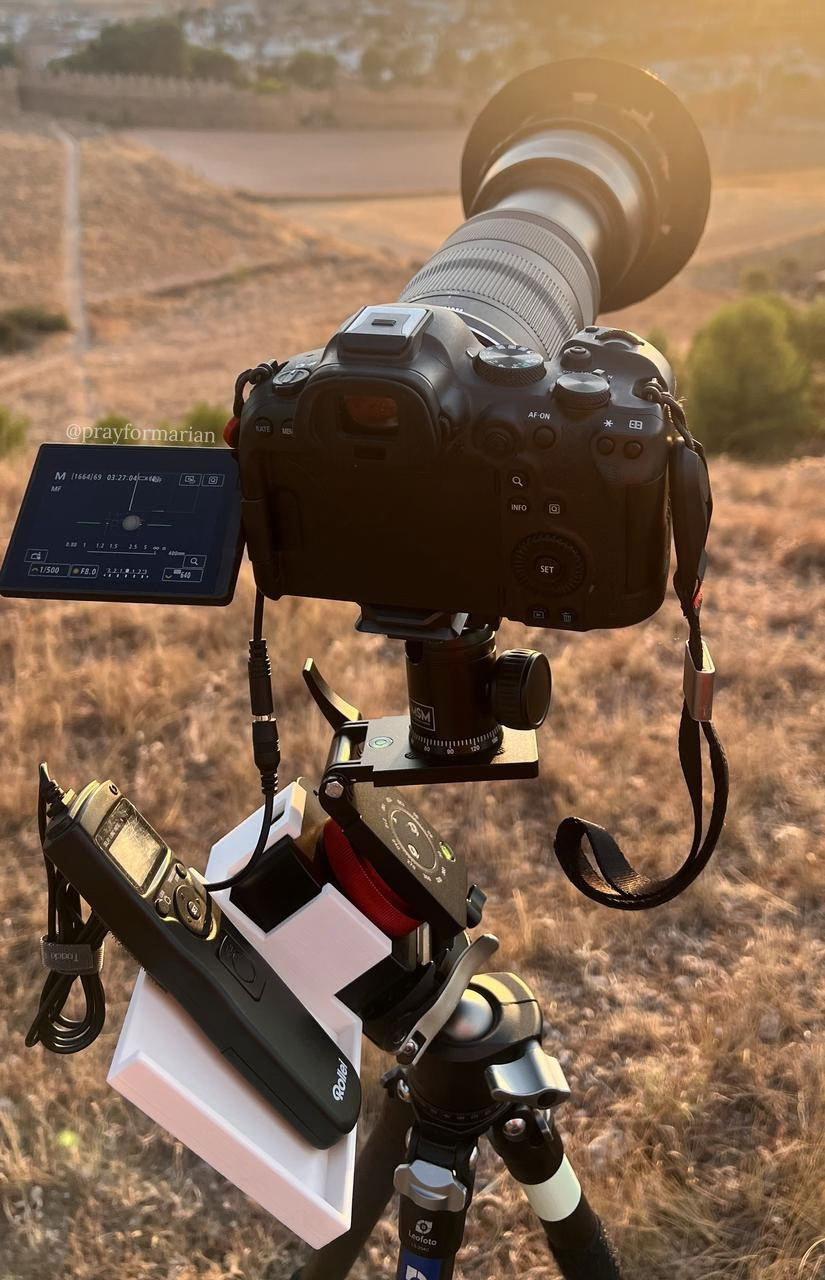
| Gear list | |
|---|---|
| Camera | Canon R6 Mark II |
| Lens | Canon RF 100-400 F5.6-8 IS USM |
| Tracker | Move Shoot Move NOMAD |
| Mounting plate | V Mount by MSM |
| Polar alignment | Eric Wilkes' 3D phone mount |
| Filter | Baader AstroSolar safety film |
| Tripod and ball head | Leofoto LS-254C+LH30 |
| Intervalometer | Rollei Cable Remote Release |
Leave a comment